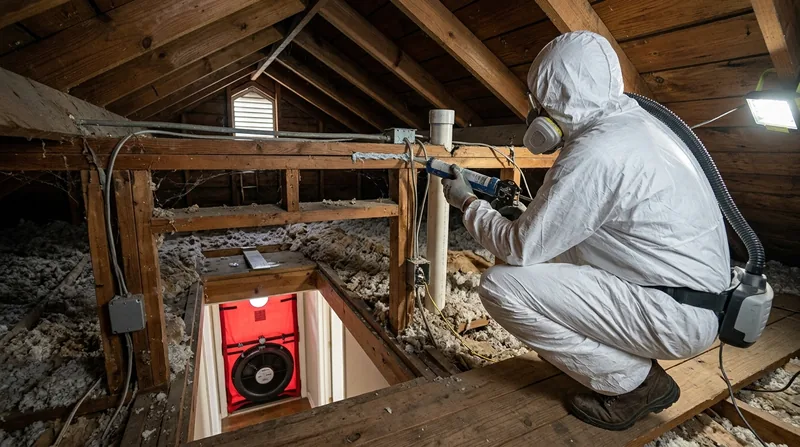




Older homes near downtown Fayetteville and across the Ozark highlands leak air through top plates, rim joists, and wall penetrations built decades ago without the sealing standards of today. Winter cold snaps expose these drafts immediately: you feel them under windows, at exterior corners, and along the roofline where the attic meets the top of the wall. Air sealing in Fayetteville closes those gaps with closed-cell spray foam and caulk, cutting the infiltration that a blower door test reveals and that your heating bill reflects every January. The region's mixed-humid climate, hot humid summers, and real winters that bring ice storms and cold snaps make air sealing a year-round concern, but it becomes urgent the moment outdoor temperatures drop and heated indoor air escapes to the attic and outdoors. We find and seal the leaks that fiberglass and blown-in insulation cannot reach, restoring the thermal boundary that your home's envelope should have maintained from the start.
Why Air Sealing Matters in Fayetteville's Older Neighborhoods
Fayetteville's housing stock near the university and downtown core runs heavily to mid-century ranches and older single-story homes with original wall cavities and attics that have never been professionally sealed. These homes were built to codes that did not require the continuous air barrier we understand today. Over decades, wood framing shrinks, drywall joints open, and penetrations for plumbing, electrical, and mechanical systems create pathways for conditioned air to escape. A blower door test during a winter cold snap will measure air leakage in the range of 8 to 15 air changes per hour in homes like these, compared to the 7 or fewer that modern code expects. That leakage costs real money every heating and cooling season.
- We locate air leaks at the top plate, the junction where the attic meets the exterior wall, using visual inspection and thermal imaging during cold weather.
- We seal rim joists and band joists where the rim band sits on the foundation, a primary source of infiltration in crawl space homes across Fayetteville and Springdale.
- We close penetrations for electrical outlets, switches, plumbing stacks, and HVAC ducts that punch through the thermal envelope without a seal.
- We inject closed-cell foam into wall cavities and behind rim joists where access allows, and we caulk all remaining gaps after foam cures.
Sealing these leaks before winter reduces the load on your heating system and cuts the drafts that make rooms feel uncomfortable even when the thermostat is set to 70 degrees.
Key info: Homes in Fayetteville built before 1980 rarely have a sealed rim joist. If your basement or crawl space feels damp and cold in winter, or if you feel drafts at the foundation line, air sealing the rim band with closed-cell spray foam will cut infiltration and reduce moisture vapor drive into the space below.
For detailed permitting and code questions specific to your address in Fayetteville, contact the Fayetteville Building and Code Enforcement Division. They can confirm what applies to your home and whether an inspection is required after air sealing work is complete.
How We Seal Air Leaks: The Process in Fayetteville Homes
Air sealing begins with a blower door test or a visual inspection during a cold snap to identify where air is escaping. We use thermal imaging to spot temperature differences at the envelope, and we walk the attic, crawl space, and rim joist area to find the gaps that matter most. Once we know where the leaks are, we plan the seal: some gaps get closed-cell spray foam, others get caulk or foam backer rod, and large voids get a combination of both. The goal is to restore the air barrier without trapping moisture in the wrong place for the season and climate.
- We inspect the attic and rim joist area to find all significant air leaks and measure them against the thermal boundary.
- We seal the top plate and rim band with closed-cell spray foam, applied in controlled passes to the thickness specified in our estimate.
- We caulk all remaining gaps, electrical penetrations, and plumbing chases with an acrylic caulk rated for the temperature range at that location.
- We ensure mechanical ventilation during foam cure and confirm a 24 to 48 hour re-entry window before the space is occupied again.
- We provide a written estimate with R-value and thickness specifications so you know exactly what you are paying for.
The result is a measurable reduction in air leakage that shows up on a follow-up blower door test and in your heating and cooling bills within the first season.
Example: A 1970s ranch in Rogers with an unfinished attic and a vented crawl space failed a blower door test at 11.2 air changes per hour. We sealed the rim joist with 2 inches of closed-cell foam, sealed the top plate at three locations where exterior walls met the attic, and caulked all electrical and plumbing penetrations. The follow-up test showed 7.8 air changes per hour, a 30 percent reduction in infiltration and a measurable drop in the heating bill the following winter.
For more on how spray foam seals walls and attics, see our page on attic spray foam insulation in Fayetteville.
Air Sealing Methods: Foam, Caulk, and Combination Approaches
| Approach | Description | Best for |
|---|---|---|
| Closed-cell spray foam | 1 to 2 inches applied to rim joists, top plates, and wall cavities; creates an air barrier and adds R-value (approximately 6 per inch). | Rim joists, band joists, top plates, and voids that require both air sealing and insulation in one step. |
| Acrylic latex caulk | Applied to gaps up to 1/2 inch wide; paintable, low odor, and rated for temperature cycling in mixed-humid climates. | Electrical outlets, plumbing penetrations, drywall joints, and small gaps in attics and crawl spaces. |
| Foam backer rod and caulk | Closed-cell foam rod inserted into gaps wider than 1/2 inch, then caulked over; bridges the gap and allows caulk to maintain flexibility. | Larger gaps at top plates, rim joists, and where framing has settled or shifted over decades. |
| Combination sealing | Foam to the rim band and top plate, caulk to electrical and plumbing penetrations, backer rod to larger voids; customized per inspection. | Older homes with mixed leak sources and varying gap widths; the most common approach in Fayetteville and Springdale. |
Each method is chosen based on the location of the leak, the size of the gap, and whether insulation value is needed at that spot. A home may need closed-cell foam at the rim joist, caulk at the electrical outlets, and backer rod at the top plate, all in the same job.
Air Sealing Cost in Fayetteville: What to Expect
Air sealing cost in Fayetteville depends on the extent of the leaks, the accessibility of the rim joist and attic, the square footage of the top plate that needs sealing, and the number of penetrations to close. A typical rim joist sealing job on a 1,500 square foot ranch with a crawl space starts at around $650 to $900 and covers 1 to 2 inches of closed-cell foam along the entire rim band plus caulking of electrical and plumbing penetrations. A larger home or one with multiple stories, or a job that includes attic top plate sealing, will run $1,200 to $2,000 or more. Homes with difficult access, extensive penetrations, or structural complexity will require an on-site estimate.
The factors that move cost upward are: the linear footage of rim joist to seal, the height and accessibility of the attic, the number of electrical outlets and plumbing stacks that require caulking, and whether the home sits on a crawl space or a slab. A home with a basement or a complex crawl space layout will cost more than a simple slab-on-grade. Travel is included in our pricing across Fayetteville and surrounding areas, so there is no separate mileage charge.
We provide a written estimate with R-value and thickness specifications before any work begins, so you know exactly what you are paying for and what the result will be. To get a free estimate, call us at (479) 480-6143 or visit our pricing page for more detail on how we structure our bids.
Getting 2 to 3 estimates from different contractors is smart. Compare the R-value, the thickness of foam specified, the scope of caulking included, and the warranty on workmanship. The cheapest estimate is often the one that cuts corners on ventilation during cure or promises immediate re-entry, both red flags that signal a job done fast rather than right.
Air Sealing Near Me: What Fayetteville Homeowners Should Know When Hiring
When you are looking for air sealing contractors near Fayetteville, verify that any contractor you call is fully insured and can provide proof of coverage. Check their references by calling past clients and asking about the quality of the sealing, whether odor was managed during cure, and whether the contractor was reachable if a question came up after the job. Ask for a written estimate that includes R-value, foam thickness, and the scope of caulking; if an estimate leaves these details out, move on. Understand what permits apply at your address by checking with the Fayetteville Building and Code Enforcement Division, and confirm that your contractor will help you navigate the permitting process if one is required.
If your home is in a master-planned community or an HOA, check your architectural guidelines to see whether exterior work on rim joists or crawl space vents requires approval. Most HOA rules do not govern insulation, but some do govern vents and access points, so it is worth asking before scheduling work. Ask your contractor whether they have experience with the specific failure mode in your home: rim joist infiltration in Fayetteville homes is common, attic leaks are common, and a contractor who has sealed dozens of homes like yours will spot the problem faster and seal it more completely than one who is new to the region.
- Request a written estimate that specifies the R-value per inch, the total thickness of foam, and the linear footage of rim joist or top plate to be sealed.
- Ask whether mechanical ventilation will be used during foam cure and confirm the re-entry window is 24 to 48 hours, not immediate.
- Verify that the contractor carries liability insurance and ask for a certificate of insurance before work begins.
- Call references and ask about the contractor's responsiveness after the job, in case odor or other questions come up during the cure period.
- Get a second estimate from another contractor to compare scope, R-value, and price, so you understand the market rate for your home.
A local contractor who has been in business in Fayetteville for years and carries local references is a safer choice than a rig-and-run crew in a trailer or a franchise that treats your home as a job number on a weekly schedule. Contact us for a free estimate and to discuss your home's specific air sealing needs.
Air Sealing in Fayetteville: Pricing Guide
| Service | Price | Details |
|---|---|---|
| Rim joist and band joist sealing | Starting at $650 | Closed-cell spray foam to rim band, caulking of electrical and plumbing penetrations, crawl space or basement homes typical |
| Rim joist plus attic top plate sealing | Starting at $1,200 | Combination job covering rim band, top plate at multiple locations, and attic penetrations; larger homes or complex layouts cost more |
| Attic top plate and penetration sealing only | Starting at $800 | Accessible attics with electrical outlets, plumbing stacks, and HVAC ducts; slab-on-grade homes without crawl space |
| Large or complex sealing project | On estimate | Multiple stories, extensive structural complexity, difficult access, or combination with insulation work requires on-site assessment |
| Travel and estimates | Free estimate, no charge for travel | Response within 24 hours at (479) 480-6143; travel included in Fayetteville and surrounding service areas |
Indicative pricing, the exact cost depends on square footage, finish, and site access. Free personalized estimate within 24h at (479) 480-6143.


