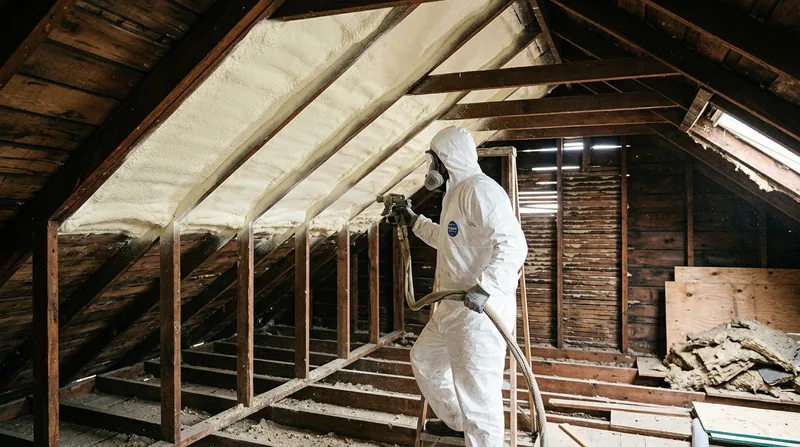




Older homes in Fayetteville and mid-century ranches across Springdale often carry insulation that has settled, compressed, or failed over decades. When your attic runs hot in summer, your crawl space stays damp, or your energy bills climb despite no change in use, insulation replacement and re-insulation in Fayetteville restores thermal control and seals air leaks that fiberglass alone cannot address. The Ozark highlands bring real winters with cold snaps and hot, humid summers that demand an insulation envelope sized for zone 4A's extremes. Spray foam insulation removes the old material and installs a continuous air barrier that stops the leakage pattern that worn batts and blown-in fiberglass leave behind. We pull out what has failed, seal the substrate, and install new foam to specification, with written estimates that name the R-value, thickness, and foam type so you know exactly what you are paying for.
Why Insulation Replacement & Re-Insulation Matters in Fayetteville's Climate
Fayetteville's mixed-humid climate pushes moisture and temperature swings that expose the limits of original insulation. Attics in older homes near downtown and along the university neighborhoods often sit unvented with fiberglass that has never been touched, while mid-century ranches in Springdale carry vented attics where the insulation has flattened under decades of heat cycling. Crawl spaces on sloped lots across Benton and Washington counties stay damp long after spring storms pass, and the wrong insulation choice traps moisture at the wrong time of year. When insulation fails, your HVAC runs longer, humidity creeps into living spaces, and energy bills reflect the loss of control.
- We remove old insulation that has settled, compressed, or absorbed moisture and no longer meets zone 4A performance standards.
- We install new foam sized for Fayetteville's hot summers and cold snaps, with continuous air sealing at the thermal boundary.
- We specify closed cell or open cell foam based on your space and use, never overselling the premium product when a simpler choice fits.
- We pull permits where required by your city and work within the building code that applies at your address.
A reset insulation envelope stops the energy loss that drives summer cooling bills and winter heating cycles across Greater Fayetteville.
Key info: Older Fayetteville homes near the university and downtown often sit over crawl spaces or vented attics with original or settled insulation. Mid-century Springdale ranches carry flattened fiberglass in vented attics that heat up to 150 degrees by mid-afternoon in July. Fast-growing subdivisions in Rogers and Bentonville have rooms over garages with thin cavity insulation and slab foundations on sloped lots. Replacement addresses the failure mode that dominates in your home's age and type.
For more detail on how spray foam handles the specific challenges of attic and crawl space insulation, see our attic spray foam insulation and crawl space spray foam insulation services.
How Insulation Replacement & Re-Insulation Works in Fayetteville Homes
The process begins with a site walk to identify what is failing, where air leaks are occurring, and what foam type and thickness will meet your building code and your energy goals. We remove old insulation carefully, inspect the substrate for moisture or damage, and address any leaks or wet areas before foam goes down. Once the cavity or surface is dry and ready, we spray foam in controlled passes, maintaining the manufacturer ratio and drum temperature so the material cures properly. We specify re-entry timing, typically twenty-four to forty-eight hours, and provide a written estimate that names the R-value, thickness in inches, and foam type so you know what you are getting.
- We inspect the attic, crawl space, or wall cavity and identify settled fiberglass, failed foam, moisture, or air leaks that are driving energy loss.
- We remove old insulation and dispose of it responsibly, leaving a clean substrate for new foam.
- We seal air leaks at rim joists, rim board, band board, ductwork, and penetrations before or after foam application, depending on the assembly.
- We spray foam in multiple passes to the specified thickness, maintaining cure conditions and mechanical ventilation throughout.
- We provide a written estimate with R-value, thickness, and foam type before any work begins.
The result is a continuous thermal and air barrier that stops the leakage pattern that fiberglass cannot address alone.
Example: A 1970s ranch in Springdale with a vented attic and 4 inches of compressed fiberglass gets 6 inches of open cell foam sprayed over the roof deck, with air sealing at the soffit vents and ridge. A 1950s colonial in Fayetteville with an unvented attic and original batts gets closed cell foam in the cavity walls and 8 inches on the roof deck to handle the damp crawl space below. A new build in Bentonville with a room over a garage gets 6 inches of closed cell foam on the underside of the roof and wall cavities to prevent condensation and maintain the R-value that the frame calls for.
For details on the difference between closed cell and open cell foam for your specific application, see closed cell spray foam insulation and open cell spray foam insulation.
Insulation Replacement & Re-Insulation Methods: Comparison
| Approach | Description | Best for |
|---|---|---|
| Attic Foam Over Existing | Spray foam directly over settled fiberglass or old blown-in, after removal of the worst material and air sealing of major leaks. | Vented attics with flattened insulation in Springdale ranches; quick reset without full tearout. |
| Full Removal and Replacement | Remove all old insulation, clean the substrate, seal air leaks, and spray foam to full specification on roof deck or cavity walls. | Unvented attics, crawl spaces with moisture, and walls with failed foam or contamination. |
| Closed Cell Spray Foam | High-density foam with R-value of 6 to 7 per inch; vapor impermeable; provides air sealing and moisture barrier in one pass. | Crawl spaces, rim joists, rooms over garages, and sealed attics where condensation control is critical. |
| Open Cell Spray Foam | Low-density foam with R-value of 3.5 to 4 per inch; vapor permeable; flexible and sound-dampening; lower cost per board foot. | Attics in dry climates or as a top-up over existing insulation; secondary air sealing layer. |
| Blown-In Fiber Top-Up | Add blown-in cellulose or fiberglass over existing settled insulation to raise R-value without foam cost. | Sound attics with minor settling; lowest-cost option when air sealing is not the primary goal. |
The method we recommend depends on what is failing, where the air leaks are, and whether moisture control is part of the problem. We walk the space, identify the failure mode, and propose the right solution, even if it is not the most expensive option.
Insulation Replacement & Re-Insulation Cost in Fayetteville: What to Expect
Insulation replacement pricing in Fayetteville depends on the square footage of the space, the depth and type of foam, the difficulty of removing old material, and whether air sealing at rim joists, band board, or other thermal breaks is included. A straightforward attic re-insulation with removal and open cell foam typically runs from $2,800 on a 1,000-square-foot space, while closed cell foam, full removal of contaminated material, or complex air sealing can move the number higher. Crawl space replacement with moisture control and closed cell foam often costs more per square foot because access is tight and the substrate must be clean and dry before foam goes down. The best way to know your actual cost is to get a free estimate with a site walk, written R-value and thickness specs, and a clear breakdown of what is included.
- Square footage is the primary driver: larger attics and crawl spaces cost more in total, but per-square-foot rates often improve with scale.
- Foam type matters: open cell is lower cost per board foot, closed cell higher but required for moisture-critical spaces like crawl spaces and rim joists.
- Removal difficulty affects labor: old fiberglass in a clean attic is straightforward, but contaminated material, asbestos-suspect vermiculite, or wet insulation adds time and disposal cost.
- Air sealing scope: sealing rim joists, band board, ductwork, and penetrations as part of the job adds value and cost but stops the leakage that drives energy loss.
- Access and complexity: tight crawl spaces, vented attics with low headroom, or metal buildings with condensation issues require more careful work and may affect the price.
Getting 2 or 3 estimates from local contractors lets you compare methods, materials, and pricing so you understand what you are paying for. See our pricing page for typical ranges and call us at (479) 480-6143 for a free estimate with no obligation.
Insulation Replacement & Re-Insulation Near Me: What Fayetteville Homeowners Should Know When Hiring a Contractor
The spray foam insulation market in Greater Fayetteville includes local independent shops, national franchises, and out-of-state crews that spray a job in an afternoon and disappear. The honest contractor walks the space, identifies what is failing and why, proposes the right solution even if it is not the most expensive, and stands behind the work with a clear warranty and a local phone number. Before you hire anyone, verify that the contractor is fully insured, ask for references from recent jobs in Fayetteville or nearby cities, and request a written estimate with R-value, thickness, and foam type so you know what you are getting.
- Ask whether the contractor is fully insured and request a certificate of insurance that covers liability and property damage.
- Get a written estimate that names the R-value, thickness in inches, and foam type (open cell or closed cell) for each area of the job.
- Check references from homeowners in Fayetteville, Springdale, Rogers, or Bentonville who had similar work done in the past year.
- Understand what permits apply at your address by asking the contractor to clarify what the local building department requires for your job.
- Ask about mechanical ventilation during cure and re-entry timing, typically twenty-four to forty-eight hours, to confirm the installer is following manufacturer protocol.
- Verify that the contractor has a local address and phone number so you can reach them if questions or issues arise after the work is done.
The best protection is a contractor who can explain the work in plain language, provide references you can call, and stand behind the job with a warranty and ongoing availability. Contact us for a free estimate and to speak with someone who knows the local market and can answer your questions.
Insulation Replacement & Re-Insulation in Fayetteville: Pricing Guide
| Service | Price | Details |
|---|---|---|
| Attic Re-Insulation with Removal | Starting at $2,800 | Includes removal of old insulation, open cell foam to 6 inches on roof deck, air sealing, and disposal on 1,000 sq ft |
| Crawl Space Replacement with Closed Cell | Starting at $4,200 | Includes removal, substrate prep, closed cell foam 4 to 6 inches on rim and band joist, moisture control, and disposal |
| Wall Cavity Injection Foam Retrofit | Starting at $3,600 | Includes drilling, injecting closed cell foam into pre-1980 wall cavities without demolition, sealing holes, and finishing on 1,200 sq ft |
| Room Over Garage with Air Sealing | Starting at $2,200 | Includes closed cell foam on underside of roof deck, cavity walls, rim joist sealing, and air sealing at band board on 400 to 600 sq ft |
| Complex or Large-Scale Job | On estimate | Metal buildings, barndominiums, full-home retrofits, or contaminated material removal require site inspection before pricing |
| Free Estimate | No charge | Response within 24 hours at (479) 480-6143, includes site walk, written R-value and thickness specs, no obligation |
Indicative pricing, the exact cost depends on square footage, finish, and site access. Free personalized estimate within 24h at (479) 480-6143.


