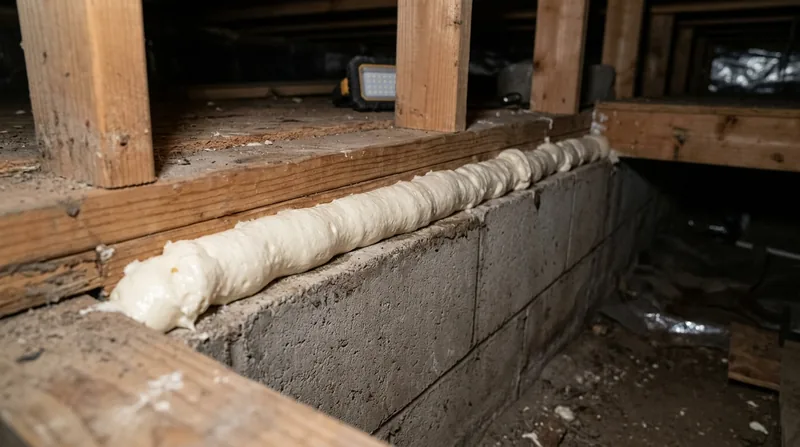




Rim and band joists are the hidden leak point in Fayetteville and Springdale homes, especially on older stock and hillside properties where foundation settling and seasonal moisture swings are the norm. These wooden rim boards sit where your foundation meets your house frame, and when they're left uninsulated and drafty, cold air pours in during winter cold snaps, heat escapes in summer, and moisture creeps in year-round from the damp crawl spaces common on Washington and Benton county lots. Rim joist and band joist spray foam seals that cavity tight, stops the draft before the next ice storm, and cuts the moisture path that leads to rot and mold. We've been sealing rim and band joists across Fayetteville since 2014, and it's one of the fastest ways to drop your energy bills and protect the wood that holds your house up. Call us at (479) 480-6143 for a free estimate, or read on to understand why this one detail matters so much in the Ozark climate.
Why Rim Joist and Band Joist Insulation Matters in Fayetteville's Climate
The Ozark highlands bring real winters with ice storms and hard freezes, and hot humid summers where moisture is always trying to move into your house. Your rim joist is the bridge between the foundation and the frame, and it sits right in the path of both. An uninsulated or poorly insulated rim joist lets cold air pour up into your first-floor rooms and into the walls above, driving your heating and cooling bills higher every season. Worse, the damp crawl spaces common on older Fayetteville and Springdale lots push moisture up through that same rim cavity, especially after the heavy spring storms that soak this region.
- Cold air infiltration through the rim joist drives up winter heating costs and makes first-floor rooms feel drafty even when the furnace is running.
- Moisture wicks up from damp crawl spaces and into the rim board itself, leading to wood rot, mold, and structural decay over time.
- Sealing the rim joist cavity with spray foam stops both the air leak and the moisture path, protecting the wood and lowering your utility bills.
- Older homes on hillside lots and mid-century ranches across Rogers, Bentonville, and Springdale are most vulnerable because their rim joists were never insulated or were insulated with fiberglass that has settled and lost its seal.
A tight rim joist is the difference between a cold, damp foundation and a dry, conditioned one.
Key info: Fayetteville and Springdale sit in IECC climate zone 4A, mixed-humid, where spring storms drive moisture into crawl spaces and winter cold snaps bring hard freezes. An uninsulated rim joist is a direct thermal bridge from the cold foundation into your living space. Sealing it with spray foam stops the leak and protects the wood from the moisture that causes rot.
For more on how moisture and air sealing work together, see our air sealing services.
How We Seal Your Rim Joist: Process and Approach in Fayetteville Homes
Sealing a rim joist with spray foam is straightforward but requires the right technique to work. We start by clearing the rim cavity of any debris, old fiberglass, or obstructions, then we spray closed-cell or open-cell foam (depending on your moisture profile and budget) into the cavity at the correct thickness and density. The foam expands to fill every gap, seals against air leakage, and creates a moisture-resistant thermal break between your foundation and your frame. The job is done in a day on most homes, and you can re-enter the space within 24 to 48 hours after cure.
- We inspect the rim joist cavity and remove old fiberglass, debris, or contaminated material before spraying.
- We spray closed-cell or open-cell foam at the manufacturer ratio and drum temperature, with mechanical ventilation running during cure.
- We apply the foam in controlled passes to achieve the specified thickness and R-value, never guessing at the depth.
- We allow the foam to cure fully and provide a written estimate with R-value and thickness specs before we start.
- We verify the job meets code and your local building department's thermal barrier and ignition barrier rules.
The whole process is fast, clean, and leaves your rim joist sealed and insulated for decades.
Example: A 1970s ranch in Springdale with a vented crawl space and an uninsulated rim joist was losing heat all winter and gaining moisture all spring. We removed the old fiberglass, sprayed 2 inches of closed-cell foam into the rim cavity, and the homeowner's first-floor rooms warmed up by 4 to 6 degrees in the first week. The crawl space stayed drier after the next rain, too.
See how crawl space insulation works alongside rim joist sealing to control moisture and temperature.
Closed-Cell vs. Open-Cell Foam for Rim Joists: Which Is Right for Your Fayetteville Home?
The choice between closed-cell and open-cell foam for a rim joist depends on your crawl space moisture profile and your budget. Closed-cell foam is denser, carries a higher R-value per inch (around R-6 to R-7 per inch), and is naturally moisture-resistant, making it the right choice for damp crawl spaces or homes on hillside lots where moisture is a real risk. Open-cell foam is lighter, softer, more affordable, and breathes, making it suitable for rim joists in drier crawl spaces or homes with good drainage and a dry basement. Both are spray-applied, both seal air leaks, and both will last for decades if the substrate is dry when we spray.
| Approach | Description | Best for |
|---|---|---|
| Closed-Cell Spray Foam | Dense, moisture-resistant foam at R-6 to R-7 per inch; vapor barrier properties; requires 2 to 3 inches for rim joists. | Damp crawl spaces, hillside homes, high-moisture regions, basements with history of seepage. |
| Open-Cell Spray Foam | Lighter, breathable foam at R-3.5 to R-4 per inch; lower cost; allows moisture to dry through the foam. | Drier crawl spaces, homes with good drainage, budget-conscious retrofits, sound dampening. |
| Removal and Replacement | Old fiberglass or failed foam removed; cavity cleaned and dried; new foam sprayed to spec. | Older homes with degraded insulation, water damage, or previous poor installations. |
| Air Sealing Only | Foam applied to seal the rim cavity without full-depth insulation; light density, minimal thickness. | Homes with existing insulation in the rim cavity that just need air sealing, or budget-first jobs. |
We'll assess your crawl space moisture, your home's age, and your budget before recommending one approach or the other. Damp crawl spaces in Fayetteville and Springdale almost always call for closed-cell; dry basements in newer subdivisions can use open-cell and save money.
Rim Joist and Band Joist Spray Foam Cost in Fayetteville: What to Expect
Rim joist sealing is one of the most affordable spray foam jobs you can do, starting at around $650 for a typical single-story home with a straightforward rim cavity and good access. The final cost depends on how much rim joist you have (a small cottage will be cheaper than a large two-story), how much old insulation we have to remove, whether the crawl space is damp (which may require moisture mitigation before we spray), and how thick you want the foam. A mid-sized Fayetteville or Springdale home with 150 to 200 linear feet of rim joist and simple access usually runs $1,000 to $1,800. Larger homes, hillside properties with complex foundations, or jobs that require crawl space prep will cost more.
The best way to know your cost is to get a free written estimate from us. We'll measure your rim joist, assess the cavity condition, recommend closed-cell or open-cell based on your moisture profile, and give you a firm price with R-value and thickness specs before we start. Most estimates are ready within 24 hours. Call (479) 480-6143 or visit our pricing overview for more detail on what moves the needle on a rim joist job.
Rim Joist and Band Joist Spray Foam Near Me: What Fayetteville Homeowners Should Know Before Hiring
When you're looking for a spray foam contractor to seal your rim joist, verify that they carry full insurance and can provide a certificate on request. Ask for a written estimate that includes R-value and thickness, not just a price per board foot or a vague range. Check references from recent jobs in your neighborhood, and ask specifically about the cure time, re-entry window, and any smell or ventilation issues they experienced. If you live in an HOA community, check whether your architectural guidelines require approval for any exterior work (though rim joist work is usually interior and rarely triggers HOA review). If your home is in a historic district or on a protected lot, verify with your local building department whether permits are required; in most Fayetteville neighborhoods they are not, but it's worth checking.
Get at least two or three estimates before you commit. A low bid with no details about thickness, no ventilation plan during cure, and a promise of immediate re-entry is a red flag. The right contractor will explain why they chose closed-cell or open-cell, will walk you through the cure time and re-entry window (typically 24 to 48 hours), and will provide a warranty on the workmanship. Call us at (479) 480-6143 or request a free estimate to see how we approach the job and what you should expect.
For a comprehensive look at what separates a quality spray foam install from a cut-and-run job, see our closed-cell foam page, which covers the technical details that matter.
Rim Joist & Band Joist Spray Foam in Fayetteville: Pricing Guide
| Service | Price | Details |
|---|---|---|
| Small rim joist (single-story, straightforward access) | Starting at $650 | Basic rim cavity seal with closed-cell or open-cell foam, up to 100 linear feet, no removal |
| Standard rim joist (two-story or larger home) | Starting at $1,200 | 150 to 250 linear feet of rim cavity, includes removal of old fiberglass, spray foam to spec, full cure |
| Complex or damp crawl space | On estimate | Hillside properties, water history, foundation settling, or moisture mitigation required before spray work |
| Travel and setup | Included | No separate charge for travel in Fayetteville, Springdale, Rogers, Bentonville, and surrounding areas |
| Written estimate | Free | Includes R-value, thickness, and labor estimate; response within 24 hours at (479) 480-6143 |
Indicative pricing, the exact cost depends on square footage, finish, and site access. Free personalized estimate within 24h at (479) 480-6143.


