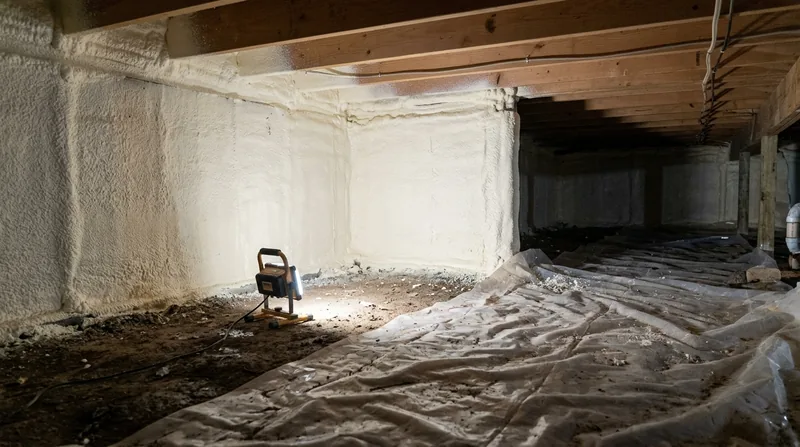




Crawl Space Spray Foam Insulation in Fayetteville stops moisture from creeping up through the rim joist and band board area, where Ozark hillside lots and spring storms leave crawl spaces damp for weeks after rain passes through. The Fayetteville-Springdale region sits in IECC climate zone 4A with hot, humid summers and real winters that bring cold snaps. Older homes on sloped terrain across Washington and Benton counties often sit over crawl spaces that trap ground moisture and reverse humidity during seasonal swings, driving cold floors in winter and making cooling bills climb in summer. We foam the crawl space walls and band joist to block that moisture path, seal the air leaks that let conditioned air escape, and stop the thermal loss that makes your heating and cooling work harder than it should. Unlike blown fiberglass or rigid board, spray foam creates a continuous seal and a moisture barrier in one pass, and it holds up in the damp environment that breaks down other insulation over time.
Why Crawl Space Moisture Control Matters in Fayetteville's Ozark Climate
Fayetteville and Springdale sit on sloped terrain where spring storms bring heavy water runoff, and crawl spaces on hillside lots stay saturated long after the rain stops. Ground moisture wicks upward through concrete, rim joists, and band boards, raising humidity in the floors above and creating conditions where mold and wood rot develop over time. Cold crawl spaces also act as thermal sinks in winter, pulling heat from the floors above and making your furnace run longer. A vented crawl space in this climate is working against you: it pulls in humid air during summer and cold air during winter, both of which cost you money and damage the structure.
- Ground moisture rises through concrete and band joists, raising humidity in floors directly above the crawl space.
- Damp crawl spaces become breeding grounds for mold and wood decay, which eventually compromise rim joists and floor framing.
- Uninsulated or poorly insulated crawl spaces pull conditioned air downward in winter, increasing heating load and utility bills.
- Spray foam seals air leaks at the band joist and blocks moisture vapor, protecting the structure and stabilizing floor temperature.
Sealing and insulating the crawl space is one of the highest-return energy improvements you can make in this region, especially on older homes where the crawl space has never been touched.
Key info: Fayetteville homes built before 1990 typically have vented crawl spaces with little or no insulation. After spring storms, these spaces stay damp for 3 to 6 weeks, and winter cold snaps turn them into thermal drains. Spray foam stops both problems at once.
How We Insulate and Seal Your Crawl Space: Step by Step
The job starts with a site visit to assess moisture, access, and the current state of the crawl space walls and band joist. We measure the perimeter and height, check for standing water or active leaks, and determine whether the substrate is dry enough to foam. If moisture is active, we stop and advise you on what needs to happen first. If the crawl space is ready, we set up mechanical ventilation, protect the area, and spray closed cell or open cell foam directly onto the rim joist, band board, and crawl space walls, creating a continuous air and moisture seal.
- We inspect the crawl space for moisture, standing water, and structural condition before any foam is applied.
- We set up mechanical ventilation during the spray and cure process to manage fumes and ensure safe conditions.
- We spray foam directly onto the band joist, rim board, and perimeter walls to create a continuous thermal and moisture barrier.
- We provide a written estimate with R-value and foam thickness, so you know exactly what you are getting.
- We allow a 24 to 48 hour re-entry window before the space is occupied or used normally.
The entire process typically takes one to two days, depending on crawl space size and access. Once the foam cures, the crawl space stays dry, floors stay warmer in winter, and your HVAC system runs less often.
Example: A 1,200 sq ft mid-century ranch in Springdale with a damp crawl space and cold floors in January gets 3 inches of closed cell foam on the band joist and rim board, plus 2 inches on the perimeter walls. The job takes one day, and the homeowner reports that floors stop feeling cold by mid-February and that the crawl space stays dry through the following spring storm season.
For more details on how spray foam works and its application in different settings, see our guide to closed cell spray foam insulation, which is the standard choice for crawl spaces because of its moisture resistance and R-value.
Crawl Space Spray Foam Insulation Methods and Foam Types
| Method | Description | Best for Crawl Spaces |
|---|---|---|
| Closed Cell Spray Foam | High-density foam (R-6 to R-7 per inch) with a closed cell structure that blocks moisture and air. Low vapor permeability and excellent thermal resistance. | Primary choice for damp crawl spaces, rim joists, and band boards in humid climates like Fayetteville. Stops moisture vapor and provides maximum R-value in thin layers. |
| Open Cell Spray Foam | Lower-density foam (R-3.5 per inch) with open cells that allow vapor to pass through. Less expensive, softer, and easier to cut and drill. | Crawl spaces in dry basements or where vapor permeability is acceptable. Not recommended in high-moisture crawl spaces because it absorbs water. |
| Band Joist and Rim Board Only | Spray foam applied only to the rim joist and band board perimeter, leaving the crawl space walls unfoamed or using a different method. | Homes where budget is tight or where crawl space walls are in good condition and moisture is not a primary concern. Stops the biggest air leak path but does not seal the entire crawl space. |
| Full Crawl Space Enclosure with Foam | Spray foam applied to all perimeter walls, rim board, and band joist, creating a complete thermal and moisture barrier for the entire crawl space. | Fayetteville homes on sloped terrain or with histories of moisture problems. Maximizes energy savings and moisture control, and is the standard for high-humidity climates. |
Closed cell foam is the industry standard for crawl spaces in the Fayetteville region because it resists moisture, holds its R-value over time, and does not degrade in damp environments. Open cell foam is less expensive but absorbs water and is not recommended for crawl spaces where moisture is a real risk. Talk to us about your crawl space condition, and we will recommend the approach that fits your situation and budget.
Crawl Space Spray Foam Insulation Cost in Fayetteville: What to Expect
Crawl space spray foam insulation in Fayetteville typically starts at $2,500 for a small, easily accessible crawl space with 2 to 3 inches of closed cell foam on the band joist and rim board. Larger crawl spaces, full enclosure jobs, or crawl spaces with difficult access, standing water, or structural issues cost more. The size of the crawl space, the depth of foam you choose, whether you are foaming only the rim or the entire perimeter, and the ease of access all affect the final price. Most crawl space jobs in the Fayetteville area fall between $2,500 and $6,000, depending on scope.
Getting two or three written estimates is the smart move. Each estimate should spell out the R-value, the foam thickness in inches, the area being foamed (rim joist only, or full perimeter), and the total cost. Avoid any estimate that does not include these details, and be suspicious of prices far below or above the market range. A complete estimate also tells you when the work will happen and what the re-entry window is.
For a detailed breakdown of pricing and what different budgets cover, visit our full pricing page. Call us at (479) 480-6143 for a free estimate with no obligation. We respond within 24 hours and will walk you through what the job includes and why the price is what it is.
Crawl Space Spray Foam Insulation Near Me: What Fayetteville Homeowners Should Know When Hiring
The spray foam market in Fayetteville and the surrounding region includes local shops, national franchises, and out-of-state crews that move from job to job with a trailer and a crew. The difference between them matters. A local contractor with a local address and local insurance is reachable if something goes wrong. A rig-and-run crew is not. Before you hire anyone, verify their insurance, ask for references you can actually call, and request a written estimate with R-value and thickness clearly stated. If an estimate has no R-value, no thickness, and no detail, walk away. That is the marker of a contractor who does not stand behind the work.
- Confirm that the contractor is fully insured and ask to see a current certificate of insurance before work begins.
- Get written estimates from at least two contractors, and compare them side by side on foam type, thickness, R-value, and coverage area.
- Ask for references from recent crawl space jobs in Fayetteville or nearby cities, and call them to ask about the quality of the work and the contractor's responsiveness.
- Understand what permits apply at your address by checking with the Fayetteville Building Department or your city's planning office.
- Ask about the re-entry window and what ventilation will be in place during the spray and cure process.
- Do not accept a price far below market or a promise of immediate re-entry, both of which are red flags for shortcuts.
We are fully insured and have been in the spray foam business since 2014. We provide written estimates with R-value and thickness, we set up proper ventilation during the job, and we are reachable after the work is done. Contact us at our contact page or call (479) 480-6143 to get started with a free estimate.
Crawl Space Spray Foam Insulation in Fayetteville: Pricing Guide
| Service | Price | Details |
|---|---|---|
| Band Joist and Rim Board Only | Starting at $2,500 | Closed cell foam on rim joist and band board perimeter, small to medium crawl space with good access |
| Full Crawl Space Enclosure | Starting at $4,000 | Closed cell foam on all perimeter walls, rim board, and band joist, medium to large crawl space, full thermal and moisture barrier |
| Large or Complex Crawl Space | On estimate | Difficult access, standing water remediation, structural repairs needed, or crawl space larger than 2,000 square feet |
| Travel and Mobilization | Included | No separate mileage fee or travel charge within Fayetteville and surrounding service areas |
| Written Estimate | Free | Includes R-value, foam thickness, coverage area, and timeline; response within 24 hours at (479) 480-6143 |
Indicative pricing, the exact cost depends on square footage, finish, and site access. Free personalized estimate within 24h at (479) 480-6143.


