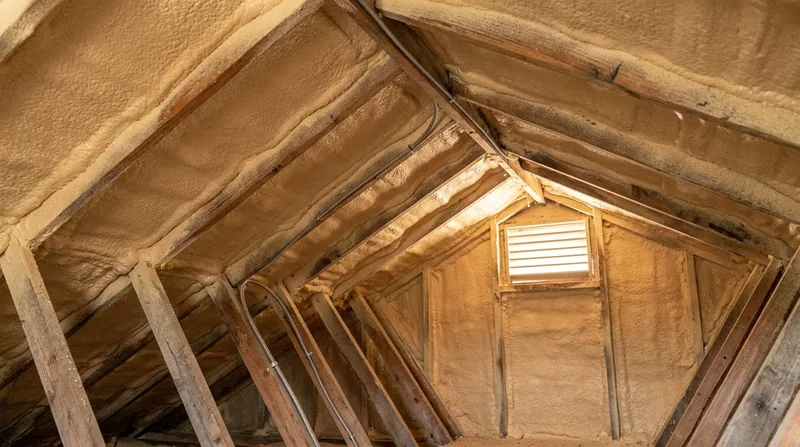




Attic spray foam insulation in Fayetteville transforms a vented attic into a conditioned space that holds steady through the region's ice storms and 95-degree summers alike. Springdale's mid-century ranches and Rogers subdivisions both push hot air down through vented attics each summer, driving cooling bills into the hundreds while winter cold sneaks in through the same path. The Ozark highlands sit in IECC climate zone 4A, mixed-humid, where humidity reverses with the seasons and the roof deck temperature can swing 80 degrees from winter to summer. Most homeowners in Greater Fayetteville find their attics are the single biggest energy leak in the house, and a sealed, foam-insulated roof deck is the most durable fix. We spray closed-cell or open-cell foam directly to the underside of the roof deck, seal every air gap, and create a conditioned attic that stops the temperature swings that waste energy and strain HVAC equipment.
Why Attic Spray Foam Insulation Matters in Fayetteville's Hot Summers and Cold Snaps
Fayetteville sits in a region where summer cooling and winter heating both demand serious work from your HVAC system. Vented attics in Springdale ranches and newer subdivisions near Rogers let the roof deck temperature soar to 140 degrees or higher on a 90-degree day, and that heat radiates down into the living space below. In winter, cold air seeps in through the same vented attic, and the temperature differential drives energy loss that a thermostat cannot stop. Sealing the attic envelope with spray foam moves the thermal boundary from the attic floor to the roof deck itself, which means the attic becomes part of the conditioned space.
- Stop hot air from radiating down through the attic floor on summer days and cutting your cooling efficiency in half.
- Eliminate winter air infiltration through soffit vents, ridge vents, and gaps around penetrations that vented attics cannot seal.
- Reduce strain on HVAC equipment by holding steady attic temperatures instead of forcing the system to fight a 140-degree space.
- Protect roof framing and sheathing from moisture damage caused by condensation when warm, humid air meets a cold roof deck in winter.
- Create usable attic space for storage or future conversion without the temperature swings that make vented attics unusable in summer.
Attic spray foam insulation is the signature job of the spray foam trade because it addresses the root cause of energy loss in this climate, not just the symptom.
Key info: Fayetteville and Springdale sit in the humid subtropical transition zone. A vented attic in a Springdale mid-century ranch loses energy in both directions: summer heat radiates down, winter moisture condenses on the cold roof sheathing. Sealed attics with spray foam insulation stop both problems at once, which is why the job has stayed consistent demand across ice storms and heat waves for nearly a decade.
For details on how closed-cell and open-cell foam compare for attic work, see our guide to closed-cell spray foam insulation.
How We Install Attic Spray Foam Insulation in Fayetteville: Step-by-Step
A proper attic spray foam installation starts with a walkthrough to measure the roof deck area, identify penetrations, check for moisture or contamination, and confirm what R-value and foam type the job calls for. We prepare the space, protect HVAC equipment and ductwork, and set up mechanical ventilation to manage off-gassing during cure. The foam is sprayed in controlled passes to the specified thickness, typically 5.5 to 7 inches for closed-cell foam (R-38 to R-49) or 8 to 12 inches for open-cell foam (R-28 to R-42), depending on your climate zone and local code. We then seal all seams, rim joists, and gaps around penetrations to create a continuous air barrier. The space is ventilated for 24 to 48 hours before re-entry, and we provide a written estimate that specifies R-value, thickness, and the foam type used.
- We conduct an on-site walkthrough and measure the roof deck area to calculate board-foot requirements and confirm R-value specifications.
- We prepare the attic by protecting HVAC equipment, ductwork, and recessed light fixtures with fire-rated barriers where code requires.
- We set up mechanical ventilation and establish a re-entry window of 24 to 48 hours to manage odor and off-gassing safely.
- We spray foam in controlled passes at the manufacturer ratio and drum temperature, building to the specified thickness with no voids.
- We seal all air gaps, rim joists, and penetrations to create a continuous thermal and air barrier from the roof deck to the walls.
- We provide a written record of the job that states R-value, thickness, foam type, and square footage, so you have documentation for permits or future reference.
The entire process from preparation to cure typically takes two to three days, with the spray itself completed in a single day on most residential attics.
Example: A Fayetteville homeowner with a 1,400 sq ft attic in a 1975 ranch called us after noticing summer cooling bills above $300. The attic had original fiberglass that had settled, vented soffit and ridge, and no air sealing. We removed the failed insulation, sealed the roof deck with 6 inches of closed-cell spray foam (R-42), and taped all seams and rim joists. The sealed attic reduced his cooling load enough to cut summer bills by roughly 25 percent, and the space stayed 20 degrees cooler in peak heat.
For more on the removal and replacement process, see insulation removal and replacement.
| Approach | Description | Best for |
|---|---|---|
| Closed-cell spray foam to roof deck | High-density foam sprayed 5.5 to 7 inches thick, achieves R-38 to R-49, creates rigid air barrier and moisture control. | Attics with high humidity risk, ice dam history, or where maximum R-value in minimal space is needed. |
| Open-cell spray foam to roof deck | Lower-density foam sprayed 8 to 12 inches thick, achieves R-28 to R-42, allows vapor diffusion, lower cost per board foot. | Attics in drier climates or where budget is the primary constraint and space is available for greater thickness. |
| Sealed attic with vented soffits and ridge sealed | Roof deck is foam-insulated, soffit and ridge vents are sealed, attic becomes conditioned space with no air exchange. | Most residential attics in Fayetteville and Springdale, where the goal is to stop the vented attic energy loss entirely. |
| Top-up of existing fiberglass with spray foam seal | Existing insulation is left in place, roof deck and rim joists are sealed with 1 to 2 inches of closed-cell foam to stop air leaks. | Attics where the existing insulation is sound and the job is to air-seal and boost R-value without full removal. |
Attic Spray Foam Insulation Cost in Fayetteville: What to Expect
Attic spray foam insulation typically starts at $1.50 per square foot and rises based on the roof deck area, the foam type (closed-cell costs more than open-cell), the R-value target, and the complexity of air sealing required. A 1,200 sq ft attic with straightforward access and a closed-cell foam application to R-40 will run higher than the same attic with open-cell foam to R-30. If the attic has contaminated or failed insulation that must be removed first, that adds to the labor and disposal cost. Penetrations, ductwork runs, and HVAC equipment that need protection also add time and materials. The best way to understand your cost is to get a written estimate that specifies square footage, R-value, foam type, and thickness, so you can compare apples to apples across contractors.
We provide free estimates within 24 hours of your call to (479) 480-6143. Every estimate includes the R-value, thickness in inches, foam type, and square footage, so you have the detail you need to make a decision. For a full pricing overview and the factors that move the cost up or down, visit our pricing page.
Attic Spray Foam Insulation Near Me: What Fayetteville Homeowners Should Know When Hiring
The spray foam market in Greater Fayetteville includes local independents, national franchises, and out-of-state crews that spray and leave. The difference between a good installation and a bad one is not always obvious until six months later, when the smell will not go away or the foam has shrunk away from the roof sheathing. A legitimate contractor will provide a written estimate with R-value and thickness specifications, not a vague price per board foot. They will explain whether permits are required at your address and defer to the local building department, because permitting rules vary from Fayetteville to Springdale to Rogers. They will set up mechanical ventilation during cure and specify a re-entry window of 24 to 48 hours, not promise immediate occupancy. They will verify their insurance with you before the job starts, and they will be reachable by phone if questions come up after the work is done.
- Request a written estimate that specifies R-value, thickness in inches, foam type, and total square footage, never a price per board foot without detail.
- Ask whether the contractor is fully insured and request a certificate of insurance naming your address as additional insured.
- Confirm that the contractor will check with the local building department to determine whether permits are required for your address.
- Verify that mechanical ventilation will be in place during the cure period and that re-entry is not permitted until 24 to 48 hours have passed.
- Get references from jobs completed in Fayetteville or nearby, and call those homeowners to ask whether the contractor was responsive after the work was finished.
- Check that the contractor has a local address and local phone number, not an out-of-state trailer or a franchise support line that does not know your neighborhood.
Taking time to verify the contractor's approach and references is the strongest protection against cut-rate work and the smell complaints that follow poor installation. Call us at (479) 480-6143 or visit our contact page to request a free estimate and speak with someone who knows the Fayetteville market.
Attic Spray Foam Insulation in Fayetteville: Pricing Guide
| Service | Price | Details |
|---|---|---|
| Closed-cell spray foam to roof deck | Starting at $1.50/sq ft | High-density foam 5.5 to 7 inches thick, R-38 to R-49, includes sealing of rim joists and major penetrations |
| Open-cell spray foam to roof deck | Starting at $1.10/sq ft | Lower-density foam 8 to 12 inches thick, R-28 to R-42, includes air sealing at roof deck and rim joists |
| Insulation removal and replacement | On estimate | Removal cost depends on insulation type, volume, and accessibility; replacement includes new foam and air sealing |
| Attic air sealing with spray foam | Starting at $800 | Targeted foam application to rim joists, penetrations, and air gaps without full roof deck coverage |
| Free estimate | No charge | Written estimate within 24 hours specifying R-value, thickness, foam type, and square footage |
Indicative pricing, the exact cost depends on square footage, finish, and site access. Free personalized estimate within 24h at (479) 480-6143.


