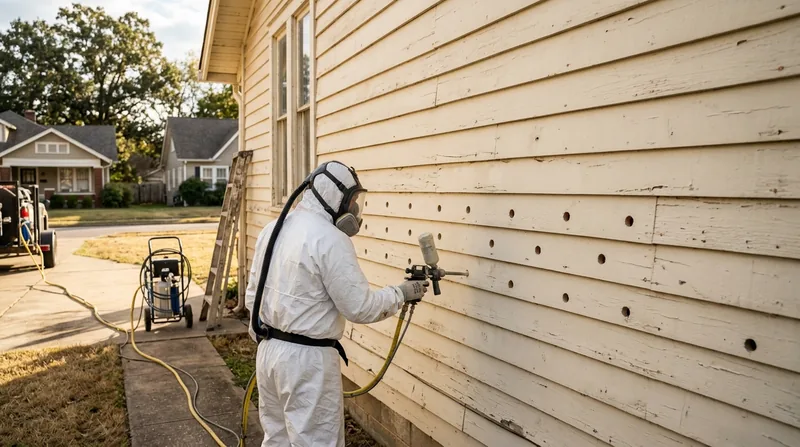




Older homes near downtown Fayetteville, Springdale, and Rogers often carry original wall cavities that were never insulated at all. Built before energy codes tightened, these walls leak cold air every winter and let heated air escape during ice storms and cold snaps that hit the Ozark highlands hard. Wall and injection foam insulation seals those cavities from the inside without tearing into finished drywall. We drill small access holes, inject closed-cell or open-cell foam into the cavity, and seal the drafts before the next winter arrives. This is the retrofit answer for pre-1980 stock across Greater Fayetteville, and it works because the foam fills every gap and hardens into an air barrier that stops the leaks your heating bill has been paying for.
Why Wall and Injection Foam Insulation Matters in the Fayetteville Area
The Ozark highlands bring real winters to Fayetteville, Bentonville, and Rogers. Cold snaps push temperatures below freezing for weeks at a time, and ice storms are common enough that energy bills spike every January through March. Homes built before 1980, which make up a large portion of the residential stock near downtown Fayetteville and older neighborhoods in Springdale, were often framed with empty wall cavities. No insulation. No air barrier. Just drywall on the inside and siding on the outside, with nothing in between but air.
- Empty wall cavities in pre-1980 homes leak cold air inward during winter and let heated air escape outward, driving heating costs up 15 to 25 percent compared to properly insulated walls.
- Injection foam fills the cavity completely, sealing air leaks that fiberglass batts cannot reach because batts are installed only at the time of construction.
- The foam hardens into a solid air barrier that stops drafts at windows, doors, and rim joists where walls meet the foundation.
- No demolition is required; we drill small holes from inside the finished wall, inject the foam, and patch the holes when we are done.
This method is the only practical retrofit for finished walls, and it is the reason older Fayetteville homes built before energy codes now lose money every winter.
Local example: A 1960s ranch in Fayetteville with uninsulated walls and a vented attic can see heating bills of $180 to $220 per month in January. Injection foam in the walls, combined with attic spray foam insulation, typically reduces that bill by 20 to 30 percent within the first heating season.
How Wall and Injection Foam Insulation Works: Step by Step in Fayetteville
The process is straightforward and non-invasive. We assess the wall cavity depth and composition, drill small access holes from the inside of the home, inject foam at controlled pressure and thickness, and patch the holes. The entire job takes one to two days depending on the square footage of wall to be insulated. Mechanical ventilation runs during the cure period to manage odor and off-gassing, and the home is typically ready for normal occupancy within 24 to 48 hours.
- We inspect the wall cavity to confirm depth, locate any existing insulation or obstructions, and determine whether closed-cell or open-cell foam is the right choice for your climate and use.
- Small access holes are drilled through the finished wall at intervals, typically 16 to 24 inches apart, to allow injection nozzles to reach the full cavity depth.
- Foam is injected at the correct pressure and drum temperature, filling the cavity from bottom to top and expanding to seal all gaps and voids.
- Once the foam has cured, the access holes are patched with drywall compound and sanded smooth, leaving no visible trace of the work.
- The finished wall is now a complete air barrier with an R-value of 3.6 to 7 per inch, depending on the foam type chosen.
Homes in Springdale and Rogers with rooms over garages or additions built without insulation are the most common candidates for this work.
Fayetteville example: A 1970s colonial near the University of Arkansas with an uninsulated addition over a garage had exterior walls that stayed cold to the touch in winter, and the room above the garage was always 10 to 15 degrees cooler than the rest of the house. After injection foam, the wall surface temperature rose by 8 to 12 degrees, the room comfort improved, and the homeowner noticed the difference within two weeks of the first cold snap.
Wall and Injection Foam Methods: Closed Cell vs. Open Cell
| Foam Type | R-Value & Properties | Best For |
|---|---|---|
| Closed-Cell Spray Foam | R-value 6 to 7 per inch. High density, rigid when cured. Acts as a vapor barrier. Low moisture absorption. | Exterior walls in the mixed-humid climate of Fayetteville and Springdale where vapor control and moisture resistance are critical during humid summers and cold winters. |
| Open-Cell Spray Foam | R-value 3.6 to 3.8 per inch. Lower density, flexible when cured. Allows vapor transmission. Better sound dampening. | Interior walls, walls that do not face exterior weather, and homes where cost per R-value is the priority and the wall assembly allows vapor to dry. |
| Injection into Existing Cavity | Same R-value as spray application. Fills cavity completely without demolition. Works with any wall depth from 3.5 to 5.5 inches. | Pre-1980 homes with finished walls and original empty cavities. No drywall removal required. Standard retrofit method for Fayetteville and Rogers older stock. |
| Partial Fill with Existing Insulation | Foam injected around existing fiberglass or mineral wool to seal gaps and air leaks. Does not remove old insulation. | Walls that have some insulation but are drafty, or where removal is not practical. Improves air sealing without full cavity replacement. |
For exterior walls in Fayetteville's mixed-humid climate, closed-cell foam is the standard choice because it controls moisture and resists the humid summers and cold snaps that characterize the Ozark highlands. Interior walls and additions over garages often use open-cell foam when cost is the driver.
Wall and Injection Foam Insulation Cost in Fayetteville: What to Expect
Wall and injection foam insulation in Fayetteville typically starts at $2 per square foot for open-cell foam in interior walls and ranges up to $3.50 to $4.50 per square foot for closed-cell foam in exterior walls. The final cost depends on cavity depth, foam type, wall accessibility, and whether the wall is interior or exterior-facing. A typical 1,200-square-foot home with uninsulated exterior walls might run $2,400 to $5,400 depending on the scope and foam choice. Homes in Springdale and Rogers with partial insulation or complex cavity layouts may require an on-site estimate because the work cannot be quoted reliably from photos or phone calls.
Factors that affect the final price include the following:
- Cavity depth determines how much foam is needed to fill the wall completely, and deeper cavities require more material.
- Foam type (closed-cell versus open-cell) has a significant impact on per-square-foot cost, with closed-cell running 40 to 60 percent higher.
- Wall accessibility, including whether walls are easy to reach from inside the home or require furniture to be moved or closets to be cleared, affects labor time.
- Exterior walls in areas with high wind exposure or moisture risk typically require closed-cell foam, which costs more than open-cell.
- Removal of existing insulation, if present, adds cost and is sometimes required before injection foam can be installed properly.
We provide written estimates that specify the R-value, foam thickness, wall square footage, and total cost before any work begins. For detailed pricing and to discuss your specific home, call (479) 480-6143 or visit our pricing page.
Wall and Injection Foam Insulation Near Me: What Fayetteville Homeowners Should Know Before Hiring
Finding a qualified spray foam contractor in Fayetteville requires the same diligence you would use for any trade. Get multiple estimates, verify insurance coverage, and ask for references from recent work in your area. Do not accept a price without a written specification that includes R-value, foam thickness, and the wall square footage being insulated. Permits for insulation work are not typically required in Fayetteville, but it is wise to confirm with your local building department if your home is in a historic district or subject to HOA architectural review. Most importantly, verify that the contractor will use mechanical ventilation during the cure period and can clearly explain the re-entry window before normal use is safe.
- Request written estimates from at least two or three contractors, and compare the R-value and thickness specifications, not just the price per square foot.
- Confirm that the contractor is fully insured and ask to see a current certificate of insurance before work begins.
- Check references from recent jobs in Fayetteville, Springdale, or Rogers, and ask specifically about odor management and cure time.
- Ask whether the contractor will use mechanical ventilation during cure and what the re-entry timeline is for your family and pets.
- Verify that the contractor will perform a site inspection and provide a written estimate with R-value and thickness specifications before committing to a price.
- Confirm whether permits are required at your address by contacting the Fayetteville Building Department or your local city building official.
The difference between a professional installation and a rushed job shows up in the quality of the estimate, the clarity of the specifications, and the care taken during cure. For a free estimate and to discuss your wall insulation needs, contact us today.
Wall and injection foam insulation is one of the most effective ways to seal drafts in older Fayetteville homes without disrupting your living space. Whether you have an uninsulated addition, a cold room over a garage, or an entire home with empty wall cavities, the solution is the same: controlled injection of closed-cell or open-cell foam, a clear written estimate, and professional installation. Call us at (479) 480-6143 to schedule your free estimate and learn how much you can save on heating bills this winter.
Wall & Injection Foam Insulation in Fayetteville: Pricing Guide
| Service | Price | Details |
|---|---|---|
| Open-Cell Injection Foam | Starting at $2.00/sq ft | Interior walls and non-critical exterior walls, lower cost per R-value, typical for additions and rooms over garages |
| Closed-Cell Injection Foam | Starting at $3.50/sq ft | Exterior walls in mixed-humid climate, vapor control and moisture resistance, standard for pre-1980 Fayetteville homes |
| Wall Square Footage Estimate | Typical 1,200 sq ft home | Ranges $2,400 to $5,400 depending on foam type, cavity depth, and exterior versus interior wall location |
| Complex or Partial Fill Job | On estimate | Walls with existing insulation, difficult access, or mixed cavity depths require on-site inspection before pricing |
| Travel and Setup | Included | No separate mileage or call-out fee within Fayetteville and surrounding service area cities |
| Free Written Estimate | No obligation | Specifications include R-value, thickness, wall square footage, and total cost; response within 24 hours at (479) 480-6143 |
Indicative pricing, the exact cost depends on square footage, finish, and site access. Free personalized estimate within 24h at (479) 480-6143.


