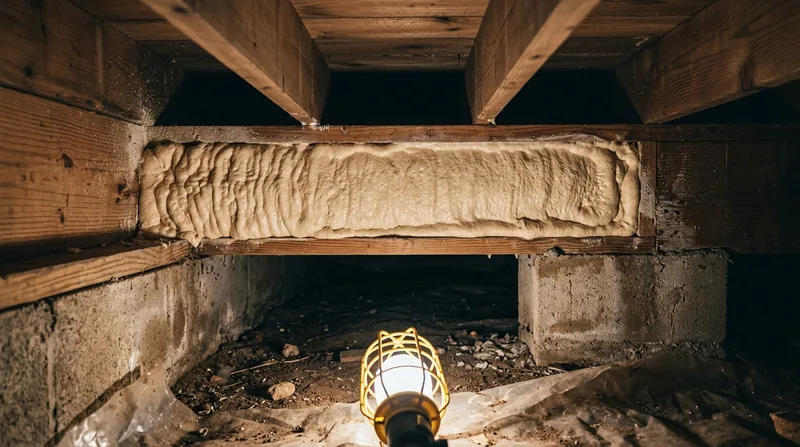




Closed cell spray foam insulation in Fayetteville delivers the dense air barrier that zone 4A's humid summers and real winters demand. Fayetteville and Springdale homes sit in the Ozark highlands where spring storms drive moisture into crawl spaces for weeks, and attic temperatures climb past 140 degrees in July before cooling season kicks in. Older homes carry original wall cavities and vented attics with flattened fiberglass that stopped working years ago. Mid-century ranches run thin insulation over garages. New subdivisions on sloped lots have rooms over uninsulated spaces and crawl spaces that stay damp long after rain. Closed cell foam solves the moisture problem that open cell cannot, adds structural rigidity to rim joists and band boards, and creates the sealed assembly that keeps your energy bills down when the weather turns extreme. We have been installing spray foam insulation across Washington and Benton counties since 2014, and we build every job to the local building code that applies at your address.
Why Closed Cell Foam Matters in Fayetteville's Humid Climate
The Ozark highlands bring two distinct failure modes: summer humidity that creeps into crawl spaces and attics from below, and winter cold snaps that reverse that moisture flow. Fiberglass and open cell foam absorb water. Closed cell foam resists it. Across Fayetteville, Springdale, and Rogers, the homes that hold their temperature and avoid ice dams in winter are the ones with a genuine air barrier and moisture control at the rim joist, the crawl space band board, and the attic deck.
- Closed cell foam stops humid air from entering crawl spaces and rim joists, the two places where moisture damage costs the most to repair.
- It adds structural support to rim boards and band joists that flex and crack under seasonal movement on hillside lots across Washington County.
- It seals wall cavities in pre-1980 Fayetteville and Springdale homes without tearing out drywall, a retrofit that open cell cannot do safely.
- It resists vapor drive in both directions, so it works in zone 4A's mixed-humid climate where the moisture threat changes with the season.
The result is a home that stays dry in spring, cool in summer, and warm in winter without the energy penalty that leaky attics and damp crawl spaces impose on your bills year-round.
Key info: A Springdale ranch with a vented attic and flattened fiberglass loses 30 to 40 percent of its cooling energy through the roof deck in July. The same home with a sealed attic deck and closed cell foam holds temperature for 6 to 8 hours longer before the AC cycles on, cutting peak-hour demand and lowering summer bills from the first month.
For more on how sealing your attic changes your energy profile, see our attic spray foam insulation page.
Arkansas requires all spray foam installations to meet the thermal barrier and ignition barrier rules set by the building code in force at your address. Your local building official in Fayetteville, Springdale, Rogers, or Bentonville sets those rules, not us. We follow them to the letter and help you understand what applies before we start.
How We Install Closed Cell Foam in Fayetteville: The Right Way
Closed cell foam is sensitive to application. Spray it too thick in a single pass and it cracks as it cures. Spray it at the wrong ratio or drum temperature and it stays soft and never reaches its R-value. We control every variable: thickness per pass, ratio, drum temperature, and mechanical ventilation during the cure window. Most homes need 24 to 48 hours before re-entry after the final pass. We state that window clearly on every estimate and remind you before we leave.
- We inspect the substrate for moisture, active leaks, or contamination before we spray, and we walk away if the surface is not ready.
- We apply closed cell in controlled passes, typically 1.5 inches per pass, building to your target thickness and R-value.
- We maintain mechanical ventilation during cure to manage VOC off-gassing and keep your home safe during the hardening phase.
- We install thermal barriers where code requires them, and we document the installation with photos and written specs on R-value and thickness.
- We provide a one-year workmanship warranty on the installation and answer questions long after the job is done.
The difference between a good installation and a bad one is invisible until years later, when a poorly applied foam starts to sag or crack, or when a home stays damp because the spray was too thin to seal. We measure and document everything so you know what you have.
Example: A Fayetteville crawl space with exposed band joists and a damp floor stays wet through spring because humid air enters the rim. We seal the rim joist and band board with 2 inches of closed cell foam, creating a continuous air barrier. The homeowner sees moisture drop by 50 percent within two weeks, and mold does not return because air no longer carries water into the space.
Learn more about crawl space spray foam insulation and how it ties into the whole-home moisture strategy.
Closed Cell Spray Foam Methods and Applications
| Application | Method | Best for |
|---|---|---|
| Attic and Sealed Roof Deck | Spray to target thickness on the underside of roof sheathing, creating an unvented, conditioned attic. | Hot attics in Fayetteville and Springdale, rooms over garages, eliminating ice dams in winter. |
| Crawl Space and Rim Joist | Spray 2 to 3 inches of closed cell on rim boards, band joists, and exposed foundation walls. | Damp crawl spaces on older Fayetteville and Rogers lots, moisture control without full encapsulation. |
| Wall Cavity and Injection Foam | Inject closed cell foam into existing wall cavities through small holes, no drywall removal. | Pre-1980 Fayetteville and Bentonville homes with empty cavities, retrofit without demolition. |
| Garage and Metal Building | Spray closed cell on interior wall and ceiling framing, condensation control on steel and metal roof. | Garages under living spaces, barndominiums, metal buildings in Centerton and Bella Vista. |
| Commercial and New Construction | Spray closed cell on roof decks, walls, and mechanical spaces before interior finish. | New commercial builds and tenant finish work across Greater Fayetteville. |
Each application starts with an on-site estimate that specifies the R-value, thickness, and square footage so you know exactly what you are paying for and what the finished assembly will perform.
Closed Cell Spray Foam Insulation Cost in Fayetteville: What to Expect
Closed cell spray foam starts at approximately $1.20 per board foot in the Fayetteville and Springdale market, though the final cost depends on several real factors. Access to the space matters: a finished attic that requires protective coverings and careful staging costs more than an open crawl space. Substrate condition matters: a wet crawl space or a roof deck with active leaks requires moisture remediation before foam can go down, and that adds cost. Thickness and R-value matter: 2 inches of closed cell gives you R-12 to R-13, while 3 inches gives you R-18 to R-19. A small rim joist job might run $800 to $1,200. A full attic on a Fayetteville colonial might run $3,500 to $5,500. A crawl space retrofit with band board sealing could be $1,500 to $2,500.
The honest way to get a real number is to call us at (479) 480-6143 and describe the space. We will schedule a free on-site estimate, measure the square footage, assess the substrate, and give you a written price with R-value and thickness specs. We will also explain what moves the price up or down so you understand the quote. Visit our pricing page for typical ranges and what they include.
Get three estimates from three different contractors. A quote with no R-value and no thickness listed is a red flag. A price far below market with no inspection is a warning sign. A contractor who promises immediate re-entry or skips mechanical ventilation during cure is cutting corners that will cost you later.
What to Look for When Hiring a Spray Foam Contractor Near Fayetteville
The spray foam market in Fayetteville and the surrounding region includes local independent shops, national franchises, and rig-and-run crews that show up with a trailer, spray a job in an afternoon, and disappear when the smell will not go away. Hiring the right one is the difference between a 30-year asset and a 5-year headache. Start by asking any contractor for proof of current insurance and the ability to verify coverage. Check whether they can provide written references from jobs in Fayetteville, Springdale, Rogers, or Bentonville completed in the last two years. Ask them to explain the R-value and thickness they are proposing and why that combination is right for your space and your climate zone. Ask about their ventilation setup during cure and the re-entry window they recommend.
If your home is in an HOA in Bella Vista or another master-planned community, confirm that the contractor understands any architectural restrictions on exterior work. If your job touches a crawl space with standing water or active leaks, ask whether they will spray over it or require moisture remediation first. A contractor who says they will spray over wet substrate is not a contractor you hire. Ask for an estimate in writing with no obligation to book. Call us at (479) 480-6143 or visit our contact page to schedule your free estimate and get answers to any questions you have.
Closed Cell Spray Foam Insulation in Fayetteville: Pricing Guide
| Service | Price | Details |
|---|---|---|
| Rim Joist and Band Board Sealing | Starting at $1.20/board ft | 2 to 3 inches of closed cell on exposed rim and band joists, moisture barrier for crawl spaces |
| Attic and Sealed Roof Deck | Starting at $1.20/board ft | Full attic spray to target R-value, unvented assembly, typical cost 3500 to 5500 for full coverage |
| Wall Cavity and Injection Foam Retrofit | Starting at $1.20/board ft | Injection foam into existing wall cavities, pre-1980 homes, no drywall removal, retrofit without demolition |
| Crawl Space Encapsulation and Sealing | Starting at $1.20/board ft | Spray closed cell on walls and joists, moisture control on damp crawl spaces, typical 1500 to 2500 |
| Garage, Metal Building, and Commercial | On estimate | Condensation control on steel, unvented metal roof, commercial shell spray, requires on-site measurement |
| Free Estimate and Inspection | Free | Written quote with R-value and thickness specs, response within 24 hours, no obligation to book |
Indicative pricing, the exact cost depends on square footage, finish, and site access. Free personalized estimate within 24h at (479) 480-6143.


