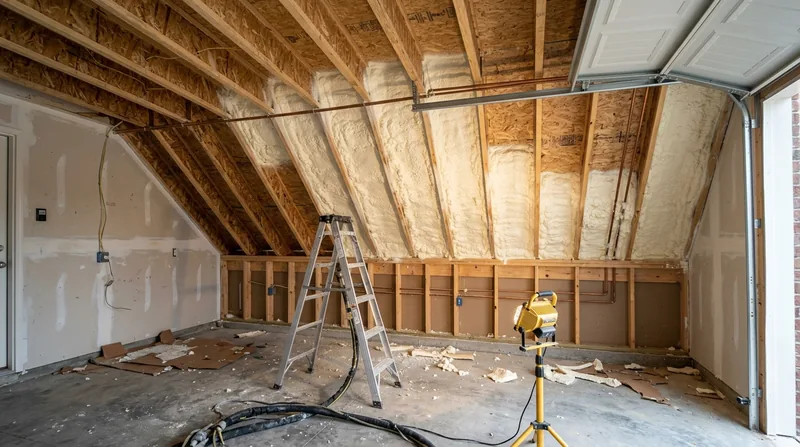




Rooms over garages in Rogers and Bentonville subdivisions often run hot in summer and cold in winter, and the shared wall and ceiling between a heated or air-conditioned living space and an uninsulated garage is one of the fastest thermal leaks in Northwest Arkansas. Zone 4A brings real winters with cold snaps and humid summers that push attic temperatures over 140 degrees, so a thin or missing cavity fill between a bedroom and a garage ceiling translates directly to a thermostat that runs harder and longer every season. Garage spray foam insulation seals that boundary, stops the thermal transfer, and evens out temperatures through the year. We spray the garage ceiling and the shared walls to create a thermal break that holds through Fayetteville's wide seasonal swings, and we do it with the precision that keeps the cure safe and the foam stable.
Why Garage Spray Foam Insulation Matters in Fayetteville and Rogers
Subdivisions built in Rogers, Bentonville, and west Fayetteville in the last 20 years often sit on slab foundations on sloped lots, with garage bays on the downhill side and living spaces above. The garage stays unheated and unair-conditioned, exposed to outdoor temperature swings that in summer can reach 140 degrees under a dark roof, and in winter can drop below freezing for weeks at a time. A standard 2x6 cavity with fiberglass or cellulose in the ceiling and shared walls offers almost no resistance to that thermal shock, so the room above the garage becomes a thermal problem zone that no amount of HVAC adjustment can fully solve.
- Rooms over garages stay 10 to 15 degrees warmer than the rest of the house in summer because the garage ceiling absorbs solar heat all day and radiates it upward.
- In winter, the same ceiling becomes a cold sink that draws heat down from the room above, forcing the heating system to run longer to maintain comfort.
- Thin or missing insulation in the shared walls between a garage and a bedroom or hallway creates draft zones where you feel cold air even when the thermostat is set to comfort.
- Spray foam seals the cavity completely, eliminating air leakage and creating an unbroken thermal barrier that does not settle, compress, or leave gaps.
The result is a stable indoor temperature, lower utility bills, and a room that feels comfortable year-round instead of a seasonal problem.
Key info: A typical room over a garage in a Bentonville subdivision with 2x6 joist cavity and fiberglass insulation loses enough heat in winter to add 15 to 25 percent to the heating bill for that zone. Spray foam in the ceiling and walls stops that loss and recovers the cost through utility savings within 3 to 5 years in zone 4A's climate.
For more context on how spray foam handles thermal barriers and air sealing in residential applications, see our attic spray foam insulation page, which covers the same principles applied to the largest thermal load in most homes.
How We Spray Foam a Garage Ceiling and Shared Walls in Fayetteville
The process starts with a site visit to measure the cavity, assess the substrate, and determine whether the space is dry and ready for foam. We specify the foam type (open cell or closed cell), the thickness required to meet your R-value target, and the number of passes needed to build the thickness safely without overdosing a single cavity. We then schedule the work, control the temperature and humidity during the cure window, and confirm re-entry conditions before you use the space.
- We inspect the garage ceiling joists and shared walls for moisture, active leaks, or contamination, and we do not spray over a wet substrate.
- We seal all penetrations, rim gaps, and mechanical chases before spraying to prevent foam from entering spaces where it should not be.
- We spray the cavity in controlled passes, holding the foam gun at the correct angle and distance to ensure even coverage and proper density without voids.
- We monitor the cure with mechanical ventilation running during the application and through the recommended re-entry window, typically 24 to 48 hours.
- We trim and seal the foam edges flush with the joists and install any required thermal or ignition barriers per local building code.
The entire job typically completes in one to two days depending on the cavity size and foam type, and the room is ready for normal use once the cure window closes.
Example: A 400-square-foot garage ceiling in Rogers with 2x6 joists and a target R-value of 21 typically takes one day to spray with closed cell foam, 1.5 inches thick, plus one day of cure before the room above is fully occupied. The shared wall between the garage and a hallway gets the same treatment, sealed completely and finished flush with the drywall edge.
For a detailed look at how we approach air sealing in residential spaces, see our air sealing service page.
Garage Spray Foam Insulation Methods: Open Cell vs. Closed Cell
| Approach | Description | Best for |
|---|---|---|
| Closed Cell Spray Foam | High-density foam that cures rigid and air-tight, with an R-value of 6 to 7 per inch. Resists moisture and air infiltration completely. | Garage ceilings and shared walls where maximum thermal performance and complete air sealing are required in a thin cavity. |
| Open Cell Spray Foam | Lower-density foam that cures soft and flexible, with an R-value of 3.5 to 4 per inch. Allows vapor to pass through and is less expensive per board foot. | Garage ceilings in deeper cavities (2x8 or 2x10 joists) where R-value stacking is possible and cost is a priority over maximum density. |
| Closed Cell with Ignition Barrier | Closed cell foam finished with a Class A thermal barrier (typically latex-based paint or intumescent coating) to meet code fire safety requirements. | Garages in all Fayetteville jurisdictions where local code requires a 15-minute thermal barrier on exposed foam in a habitable space above. |
| Partial Fill with Blown Insulation | Spray foam air sealing at rim and penetrations, with blown cellulose or fiberglass filling the cavity. Lower cost, lower R-value per inch, requires mechanical ventilation if vapor control is a concern. | Garages with existing sound cavity insulation that needs air sealing only, or where budget constraints rule out full foam coverage. |
The choice between closed cell and open cell depends on your cavity depth, your R-value target, and your budget. Closed cell is the standard for garage ceilings in zone 4A because it delivers high R-value in a thin space and seals air leakage completely. Open cell is a lower-cost option if your joists are deep enough to accommodate 4 to 5 inches of foam. We provide a written estimate with R-value and thickness specified for your specific cavity, so you know exactly what you are getting before we start.
Garage Spray Foam Insulation Cost in Fayetteville: What to Expect
Garage spray foam insulation in Fayetteville typically starts at $1,200 for a small garage ceiling (under 300 square feet) with closed cell foam, 1.5 inches thick, and escalates based on cavity size, foam type, and labor access. A typical 400 to 500 square foot garage ceiling in a Rogers or Bentonville subdivision runs between $1,800 and $2,600 depending on joist depth, the presence of shared walls, and whether existing insulation must be removed first. The largest cost drivers are the total board feet of foam required (measured on site and billed at the board foot), the number of passes needed to build thickness safely, and the time required for mechanical ventilation and cure monitoring.
- Cavity size is the primary cost factor: a 300-square-foot garage ceiling costs significantly less than a 600-square-foot ceiling in the same joist cavity.
- Foam type matters: closed cell runs higher per board foot than open cell, but delivers R-value faster, so a thin cavity often costs less with closed cell than with open cell.
- Shared walls between the garage and the house add square footage and cost, but they are often the highest-impact air sealing opportunity in the whole assembly.
- Existing insulation removal adds labor time and disposal cost, but is necessary if the old insulation is compressed, wet, or contaminated.
- Access and working height affect labor time: a garage with a low ceiling or obstructed joists takes longer than an open, clear cavity.
The best way to understand your actual cost is to get a written estimate with R-value and thickness specified. We provide free estimates within 24 hours at (479) 480-6143, and we always explain the factors that move the price up or down so you can make an informed decision. See our full pricing page for more detail on how we structure our estimates and what's included at each service level.
Garage Spray Foam Insulation Near Me: What Fayetteville Homeowners Should Know When Hiring a Contractor
Choosing a spray foam contractor for your garage ceiling is a decision that affects your comfort, your utility bills, and the long-term stability of the foam itself. The market includes local independent shops, national franchise operations, and rig-and-run crews that spray a job in an afternoon and disappear when the smell will not go away or the foam develops issues. The difference between a sound installation and a problem job is visible in the estimate itself: a contractor who specifies R-value and thickness in writing, explains the foam type and why it is right for your cavity, and commits to mechanical ventilation during cure is demonstrating the expertise that matters. A contractor who offers a price per square foot with no R-value, promises immediate re-entry, or cannot describe their insurance coverage is signaling a shortcut approach that often ends badly.
- Ask for a written estimate that includes the R-value target, the foam type (open cell or closed cell), the thickness in inches, and the total board feet of foam required.
- Verify that the contractor is fully insured and ask for a certificate of insurance naming you as an additional insured for the duration of the work.
- Confirm that the contractor will run mechanical ventilation during the spray and cure period, and that they will specify a re-entry window (typically 24 to 48 hours) before you occupy the space.
- Ask whether the local building department requires a permit for spray foam in your garage, and confirm that the contractor will help you navigate what applies at your address.
- Get references from recent garage insulation jobs in Fayetteville, Springdale, Rogers, or Bentonville, and ask those homeowners about the smell, the cure time, and the comfort improvement they experienced.
- Check the contractor's longevity: a shop in business since 2014 with a local address and local plates is positioned to stand behind the work and be reachable if questions arise later.
The goal is a contractor who treats your garage as a precision job, not a volume play. If you are ready to get started, contact us for a free estimate, and we will walk you through every step of the process and answer your questions before we spray a drop.
Garage Spray Foam Insulation in Fayetteville: Pricing Guide
| Service | Price | Details |
|---|---|---|
| Small garage ceiling (under 300 sq ft) | Starting at $1,200 | Closed cell foam, 1.5 inches, complete coverage and air sealing, includes thermal barrier application |
| Standard garage ceiling and shared walls (400-500 sq ft) | Starting at $1,800 | Closed cell foam, 1.5 to 2 inches, full cavity coverage, rim and penetration sealing, mechanical ventilation during cure |
| Large garage or multiple zones (600+ sq ft) | Starting at $2,600 | Closed cell or open cell foam, thickness and passes determined by cavity depth and R-value target, includes insulation removal if required |
| Travel and equipment setup | Included | No separate mileage or call-out fee in Fayetteville and surrounding service areas in Greater Fayetteville |
| Free written estimate | Free | Response within 24 hours, includes R-value and thickness specifications, no obligation to book, (479) 480-6143 |
Indicative pricing, the exact cost depends on square footage, finish, and site access. Free personalized estimate within 24h at (479) 480-6143.


